No obligation
Contacting Rush or starting an evaluation does not mean you must donate. You can stop at any time.
I'm Steve Weber, and I'm searching for a living kidney donor.
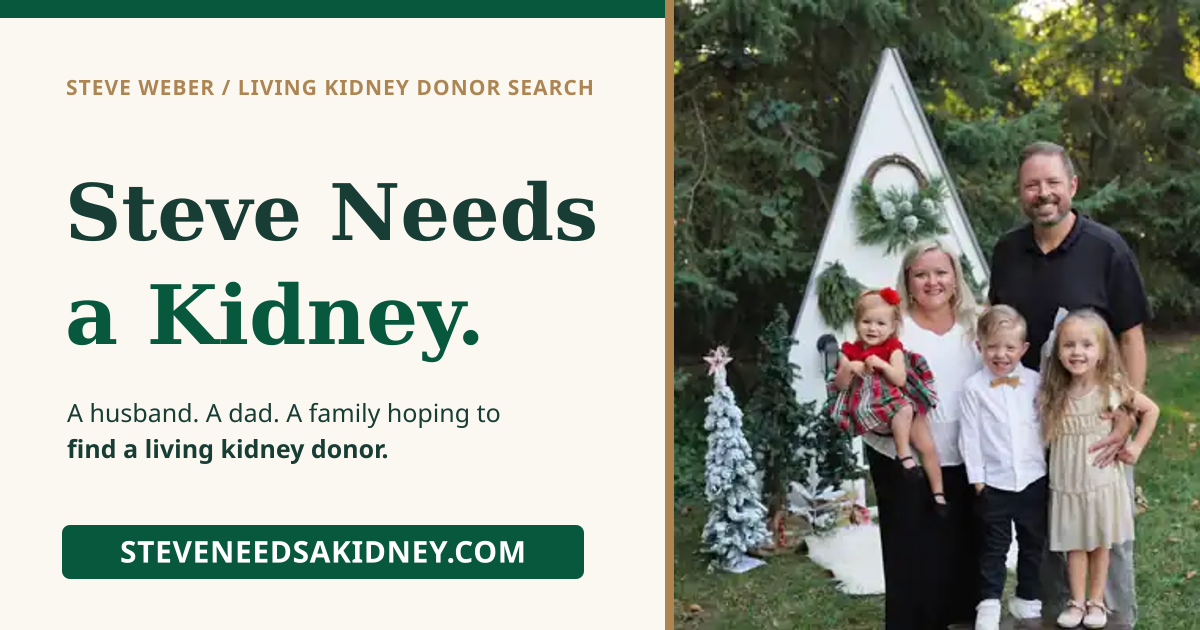
I'm a husband, a father of 4 year old twins and a 2 year old, a business owner, and have been living with IgA Nephropathy for 33 years. With my kidney function declining, we're now taking the first steps toward a transplant, hoping to get there before I ever need dialysis.
We're putting our story into the world and trusting God that it finds the right person. No pressure or obligation. Just an open door.

Exploring living kidney donation starts with asking questions, not making a commitment.
Contacting Rush or starting an evaluation does not mean you must donate. You can stop at any time.
Rush handles donor inquiries and testing confidentially. You do not have to tell our family you're considering it.
Don't know your blood type, or think yours is different? Rush can explain testing and possible paired-exchange options.
My insurance covers donor evaluation and donation surgery. Donors are not charged for these medical services. Rush can explain assistance for other expenses.
A look at the kidney disease behind my transplant journey.
IgA nephropathy is a chronic kidney disease that can gradually damage the filters in the kidneys.
IgA is an antibody that all of our bodies naturally produce to help fight infections. In my case, my body makes too much of an abnormal form of IgA. Other antibodies and proteins attach to it, forming clumps that collect in the tiny filters inside my kidneys. Over time, that buildup causes inflammation and scarring, making it harder for my kidneys to filter waste from my blood. My kidney function has declined, and I'm now beginning the transplant registration and evaluation process.
I'm not on dialysis, and I hope to never be. My kidney function has had its ups and downs, and we're doing everything we can to stay ahead of what comes next. A kidney from a living donor offers the best opportunity for a successful transplant and more healthy years with my family.
I don't want anyone to feel they owe me anything. We are simply putting our story into the world and trusting God that it finds the right person. My wife, our three children, and I are deeply grateful for every prayer, every shared link, and every kind word.
Faith, family, and hope are carrying us through this.
eGFR is a number doctors use to estimate how well the kidneys filter waste from the blood. Generally, a higher number means better filtering. It's not a percentage of kidney function.
For adults ages 40 to 49, the average eGFR is about 99. My latest reported value is 24. That comparison helps explain why we're beginning the transplant process now, even though I'm not on dialysis.
My hope is to receive a living donor kidney before I ever need dialysis. Finding a donor early gives us time for careful testing and planning.
At an eGFR of 20 or below, eligible adults can begin accruing waiting time for a deceased-donor kidney. It's not an automatic transplant date. A living donor transplant can be planned based on medical needs.
Numbers shown are eGFR estimates, not a percentage of kidney function. Age-group average: National Kidney Foundation. Waiting-time policy: HRSA / OPTN. My value reflects the most recent result I've shared, not a live medical reading.
On October 26, we met with the transplant team at Rush. We left feeling much more comfortable about the process and what comes next.
There are still quite a few tests ahead for me. The team told us the full screening and evaluation typically takes about two months. Now we begin the search for a living kidney donor.
We are grateful for every prayer and every person willing to share our story.
Help share our story ↓My kidney function can fluctuate. This is the latest number I've chosen to share, not an automatically updated lab result.
Understand what eGFR means ↗You don't have to decide anything today. Here's how to explore the possibility.
Complete Rush's confidential living donor interest form or call its donor team. Enter Steve Weber as the intended recipient.
The transplant team explains the process and, if appropriate, arranges health screening and tests. Your health and wishes come first.
If donation is possible, it's entirely up to you whether to continue. You can change your mind at any time, and Rush protects your privacy.
All donor inquiries, testing, and medical decisions are handled by Rush Living Kidney Donor Transplant Services, not by our family.
When contacting Rush, please identify Steve Weber as the intended recipient. You do not need to tell our family that you inquired or are undergoing testing.
Open Rush's donor form ↗Call (312) 947-4438
or (312) 947-GIFT
Rush's official website: Living Kidney Donor Transplant Services ↗
These answers are general information. Rush's transplant team can explain what applies to you.
No. Speaking with the donor team or beginning evaluation does not commit you to surgery. You can stop the process at any time, for any reason.
Rush protects donor confidentiality. You are not expected to tell Steve or his family whether you inquire or test. You can share that information yourself if you wish.
You can still inquire. The transplant team can arrange blood typing as part of the process if appropriate.
You may still have options. Rush participates in paired kidney exchanges that can help incompatible donor-recipient pairs. Rush will assess compatibility and possible alternatives.
Rush generally requires potential living donors to be over 18, in good physical and emotional health, and willing to complete an evaluation. The medical team determines individual eligibility.
No charge for donor evaluation or donation surgery. Steve's insurance covers those medical costs through Rush. Nonmedical expenses such as travel, childcare, and time away from work may still arise; Rush can explain assistance programs.
Most carefully screened living donors lead normal, healthy lives with one kidney. Donation is still major surgery, with short- and long-term risks. Rush evaluates those risks individually and recommends lifelong health follow-up.
Recovery varies by individual and surgery. Many donors return to light daily activities within weeks, but full recovery and lifting restrictions can take longer. The transplant team can explain a realistic timeline for your work and lifestyle.
Not matching directly does not necessarily end the conversation. In paired exchange, you may donate to another recipient while Steve receives a compatible kidney from another donor.
Read the National Kidney Foundation's donor risk guide and ask Rush for an individualized risk discussion with the independent living donor advocate.
"We ask for your prayers, that God's hand remains over every step, and that this story reaches the person who might be the right match."
Donation isn't right for everyone. A prayer, a conversation, or sharing this page can help our story travel farther than we ever could on our own.
Print a flyer or a small card to share at church, work or in your community. The QR code on each printed piece takes people to this website.